Study of youth perception about contemporary Media
(With special reference to Media students)
Dr. Saket Raman
Sr. Assistant
Prof/Media Coordinator
IQAC Coordinator,
Amity School of Communication
Amity University Rajasthan
Kant Kalwar, Jaipur-303007
Mob-8827417230, 9461087519
Abstract:
Communication
is a process by which information is exchanged between individuals through a
common system of symbols, signs, or behavior. The general means of
communication that share data, information and fact on a mass level is
categorized under mass media. The traditional role of mass media in the society
is to inform the people about various facts and happening taking place in their
surroundings. The different form of media used by the people in general is
print, television, radio, and internet, etc. There was a time when information
released to mass media was blindly considered as ultimate truth by the people
but today each and every information is rechecked for
its authenticity on every level. It means the authenticity and credibility of
the media is decreasing day to day. The people perception has changed
drastically in the last decade after the advent of 24*7 News channels. The
media are a pervasive nearness in the lives of contemporary youth. The TV
programs they watch, the music they tune in to, the computer games they play,
and the sites they visit all have a noteworthy impact in youngsters' lives,
offering them a surge of various encounters, thoughts, and learning.
Additionally, advancements in interchanges innovation bring the media into
youngsters' compass as at no other time. With the ascent of advanced stages and
the development of the Web, the measure of time youngsters go through
connecting with the media has risen altogether.
Social
media came up as the biggest revolution in the lives of people and giving them
power to express their thoughts in front of their preferred audience and to
challenge the false coverage and presentation of the mainstream media. Effects
of yellow journalism has lead to a big amount of distrust amongst the common
people towards media, which is why people from the media are deviating from
their field and trying for a change. Journalism that needs the highest amount
of skill and dedication has now become a field people fear of choosing due to
its decreasing credibility and power in terms of their authenticity. The youths
are the changing forces in the contemporary world and they are the future
stewards. In India more than 50% percent of the population is youth and they
are the major consumers of media products. So the study of their perception
towards the media is essential and relevant. The objective of this study is to
analyze the perception of people, especially the media and communication
students towards the different media and communication platforms. The
researcher through the case study method tried to highlight some important
issue and discourse on the same. The second method of study was sample survey
in which researcher has tried to collect a sample of media and communication
students purposively and also tried to investigate the perception of the youths
with special reference to media students.
Key
Words: Communication, Media, Credibility, Youth,
Perception.
Introduction:
The
traditional role of mass media in the society is to inform the people about
various facts and happening taking place in their surroundings. The different
form of media used by the people in general is print, television, radio, and
internet, etc. There was a time when information released to mass media was
blindly considered as ultimate truth by the people but today each and every
information is rechecked for
its authenticity on every level. From pamphlet type newspapers to social
networking sites, the Indian media has seen a drastic change in its channels,
values, ethics, style and processes. Advancement in technology has just
increased its impact on the masses and made it yet more powerful.
The
first and foremost function of media in a society is to provide news and
information to the masses. People need news for various reasons, at one hand it
can be used to socialize and on the other hand to make decisions and to
formulate opinions. Entertainment would be another function of mass media where
it is mostly used by the masses amuse them after their hectic schedule. Educating
the masses about their rights, moral, social and religious is another important
function of mass media, which needs no emphasis. People have put their trust in
the media as an authority to give them news, entertainment and education. The
media has a huge impact on society in shaping and reforming public opinion. Now
a days media are working on pre set agenda to formulate the public opinion.
Many people, not only those in authority, but even common man have started
feeling that the media have become irresponsible and needs to be reined in.
Media
and youth: different perspectives
According to Cambridge dictionary youth means the period of our life when
we are young, or the state of being young. It is the
period between childhood and adult age and the qualities of vigor, freshness, or
immaturity as associated with being young. Rather than being a universal and unchanging life stage,
“youth” is a relative, culturally constructed concept that has varied between
different historical and geographical contexts. A wide range of social,
economic, and political forces contribute to the way youth is
defined and understood, but the media play a crucial role as well. They
influence social attitudes toward youth as well as young people’s perception of
themselves. Media is a plural of medium, refers to the means of communication, as radio and television, newspapers, magazines, and the Internet, that
reach or influence people widely. The
media are a pervasive nearness in the lives of contemporary youth. The TV
programs they watch, the music they tune in to, the computer games they play,
and the sites they visit all have a noteworthy impact in youngsters' lives,
offering them a surge of various encounters, thoughts, and learning.
Additionally, advancements in interchanges innovation bring the media into
youngsters' compass as at no other time. With the ascent of advanced stages and
the development of the Web, the measure of time youngsters go through
connecting with the media has risen altogether. Presently, youth live in a
situation immersed with the media. They appreciate expanding access to TV,
motion pictures, music, recreations, sites, and publicizing—regularly on take
measure devices. There is a solid causal association between youth introduction
to savagery in the media and vicious or forceful conduct and thoughts. It is
trendy to accuse the media for everything that troubles society today. Media
today affects youth. Be it TV, PCs, computer games, long range interpersonal
communication locales – it gigantically impacts all parts of an adolescent's
life. In any case, all isn't terrible with the media. On the off chance that utilized
right, media can change lives for good.
Social
Networking and youth participation
Social media came up
as the biggest revolution in the lives of people and giving them power to
express their thoughts in front of their preferred audience and to challenge
the false coverage and presentation of the mainstream media. According to the survey conducted by Fortis Healthcare,
more than 74 per cent of students think that social media is the best platform
for information, facts and latest happenings. “Social media has a far-reaching
impact on the minds and behaviour of youth today. Their lifestyle choices,
likes and dislikes are being fashioned by what they see on online and
electronic media,” said Dr Samir Parikh, head of the department of mental
health & behavioral sciences at Fortis Healthcare. Individuals spend more
than expected hours on person to person communication locales to download
pictures, peruse through updates look for stimulation and visit around with
companions to keep themselves associated with each other. These destinations
have held a dependence on the young wherein they think that its hard to focus
on their work and favor signing in and hopping crosswise over one site to
another. Some have inferred advantage out of these destinations while some have
turned out to be scholastically tested by the utilization of these sites.
People have set their own particular constrains in the matter of when and when
not to get to these sites but rather we witness not very many out of the parcel
who does not access or make utilization of these destinations by any stretch of
the imagination. Social networking sites have taken the world by a tempest
prompting nothing not as much as an upheaval. A great deal of concerns have
been voiced about long range informal communication locales assuming control in
our lives. In any case, one noteworthy issue that has been disregarded is the
evolving attitude of the adolescent because of the long range informal
communication locales.
Decreasing
credibility and futuristic aspects
Effects
of yellow journalism has lead to a big amount of distrust amongst the common
people towards media, which is why people from the media are deviating from
their field and trying for a change. Journalism that needs the highest amount
of skill and dedication has now become a field people fear of choosing due to
its decreasing credibility and power in terms of their authenticity. In 2014 the phrase “lying press” was chosen the
“Ugliest Word of the Year” because, as the jury explained, it already served in
the First World War and then during the Nazi regime to defame independent
media. Although newspapers currently face a crisis
on how to make the news profitable in the digital age. Even if, the trend is
changing with a fast pace, but studies still believe in supremacy of print over
other means.
Despite this, the Pew survey showed most
respondents still think watchdog journalism is critically important. The poll
also monitored consumers’ most-used news medium, finding audiences tend to
obtain national and international news from TV and the Internet.
National News Association (NNA) found the majority of respondents
spend at least 40 minutes a week reading their local newspaper and often prefer
the print over the online edition. In a
study
conducted by Cision, Insights
from 1,550 of North America’s top journalists and influencers point toward a
severe dip in trust. Ninety-one percent of journalists believe the media is
somewhat or much less trusted than they were in past years. This lack of trust
aligns with the 2017 Edelman Trust Barometer, revealing
trust is at an all-time low. Many traditional
and non-traditional media outlets report and comment on how the Internet and
social media, especially social networking, have begun to seriously affect news
organizations. The youths are the changing forces in
the contemporary world and they are the future stewards. In India more than 50%
percent of the population is youth and they are the major consumers of media
products. So the study of their perception towards the media is essential and
relevant. The main aim of this study is to analyze the perception of people,
especially the media and communication students towards the different media and
communication platforms.
Objectives:
To study the perception of the young generation (Media
students) about Media and its products.
To know the youth (Media students) perception towards
contemporary journalism.
To study the perception of youth on Media credibility.
Methodology:
The
researcher through the case study method tried to highlight some important
issue and discourse on the same. The four cases were selected purposefully to
fulfill the specific requirement of the study. The second method of study was
sample survey in which researcher has collected a sample of 100 media and
communication students purposively and also tried to investigate the perception
of the youths with special reference to media students. Because this study is
specific in nature, so that purposive sampling method was suitable for the
investigation.
Result, Interpretation and discussion:
Case
studies: The researcher has selected
four cases from different websites and analyzed the same to highlight the fake
and sensational coverage of the content by renowned news channels.
Case
1: Obama found with youngest wife!!
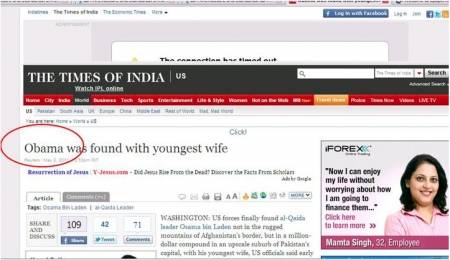
Interpretation and discussion: Above news was published by the reputed Times of India
and the heading is controversial and contradictory to the content. The website
used the name of OBAMA on the name of OSAMA. This heading is defamatory and
anyone can file a defamation suit. This type of content would also hamper the
authenticity of the publication house as well as the reason of decreasing the
credibility of the media. The entire story was associated with Osama-Bin-Laden,
but in heading use of Obama made the content fake or inauthentic. It is a
general norm that once you lose the credibility, for reestablishment of the
same you have to work hard. Youth are major consumers of the news website and
as far as the youth perception concerns they instantly make their opinion and
on the other hand instantly change the same after minutes. Basically, it is the
common characteristics of this age group. In that case you have to take proper
caution and care while targeting the youth audience.
Case 2:

Interpretation and discussion: In above case India Today manipulated the fact and
original content and elaborated the things in very sensational format, which
created a disgusting and confusing atmosphere. India Today, through its Twitter
account created a total stir in industry by twisting the statement of Shabana
Azmi which led to a lot of misinterpretation, misunderstanding and outrage. As
per the above screenshot India today twisted the original statement of Azmi.
From her statement, it would assume by anyone that she felt that such a film
cannot be made if it hurts a particular community sentiment. For this alleged
statement she was ridiculed by all the sundry, but when one saw the original
video in the tweet, one can easily see that she said something totally
different. Azmi had in fact said that she believed they could never make a film
which would be inflammatory or would hurt the sentiments of a particular
community but India today totally twisted her statement and arguments.
Case 3:

Interpretation and discussion: Again, we picked a case related to the Times of India
official twitter. Being a historical and reputed English daily TOI should be
more cautious about its responsibility, but TOI made a blunder mistake and
Doordarshan taught TOI a lesson. Above screenshot of both Twitter discussion
displays the entire conversation on their twitter account. About India v/s
Australia test match TOI twitted that India won the first test on day four by
an inning and 135 runs. But actually it was the second test of the four match
series. Such type of ridiculous mistakes never be appreciated and it’s become a
big issue when TOI is involved. It will hamper the credibility of the brand.
Case 4:

Interpretation and
discussion: The Above screenshot
shows the both online portals are totally confused about the nationality of the
rape victim. One channel reported her as Spanish national on the other hand the
second channel reported as German woman. Both channels are big brand in Indian
Media industry and if they are not sure about their nationality of a victim
they what can we say about the small one. These types of mistakes are common in
Indian Media and this type of coverage is hampering the credibility and
authenticity of the channels. In this study researcher has just picked a few
case as examples.
Sample survey: The researcher has selected 100 samples from different Media
colleges and University departments and studied them through well structured
online questionnaire. The samples were selected through purposive sampling
method due to the specific nature of the research problem.
 Graph I
Interpretation and
discussion: The most popular source of
News and information for the young generation is Digital Media as 73 % young
students uses this platform for information gathering. 17% students depend on
Electronic Media for information and news gathering and rest 10 % uses Print
Media platform for information and news. This data describe the contemporary
trend that how digital mediums are emerging as a big information hub and a
favorite one of the youths. This trend also describes the fast digitalization
of media and shows how digital media are more preferred by the youth in
comparison to Print and electronic.
 Graph
II
Graph
II
Interpretation and
discussion: As per graph 2, Digital
platforms emerged as the popular and most favorite news gathering platform. 41%
Youth respondents use News apps for new gathering, while 30% use News site for
the same purpose. This trend shows that maximum population is involved with new
media platforms for news gathering and declare them as their favorite news
gathering platform. Only 15% respondents use News channel and 14% are dependent
on Newspapers for news. This graph represents the increasing popularity and
importance of digital platforms like News sites and News apps.
 Graph
III
Graph
III
Interpretation and
discussion: As per graph 3 when asked
about their preferred Media content type, a maximum 43% respondents preferred Entertaining
content, while 12% like News, 11% respondents prefer news based content, 13%
respondents likes the satirical type of content, next 11% prefers sport related
content, while 7% likes other type of content published/broadcasted by
different Media platforms and only 3% people preferred Opinion or Opinion based
content. This major trend expresses the nature and priorities of youth
respondents.
 Graph
IV
Graph
IV
Interpretation and
discussion: As per graph 4 a maximum
number of respondents are suspicious about the credibility of Media content.
Only 33% respondents never suspect the credibility of Media products, 13%
respondents always have suspicions about the credibility of Media content, 35% of total
respondents were sometimes suspicious about the credibility and next 19%
usually suspects the credibility. Always, sometimes and usually can be counted
in favor and Never in against. The trend shows the decreasing credibility of
the Media content among the audiences/viewers and reader.
 Graph
V
Graph
V
Interpretation and
discussion: As per graph 5 due to
their suspicion on Media content youth crosscheck the information from other
sources. 63% of total respondents sometimes validate the information from some
other source, while 22% always validate the authenticity of information and only 15%
respondents never validate the information from other sources. That means
youth is cautious about the media
content and maximum number trying to validate the
information from other available sources.
 Graph
VI
Graph
VI
Interpretation and
discussion: As per graph 6 maximum number
of Youth respondents accept that Media twist the fact for its own benefit and
became more self centric. 37% respondents accept that Media always twist the
fact for its own benefit, while 27% respondents accepts that Media sometimes
twists and manipulate the fact for its own benefit and only 36% respondents
accepts that Media never twists the fact for its own benefit. But the maximum
accepts the manipulation and twisting practice and this in the long run will affect
the credibility of Media.
 Graph
VII
Graph
VII
Interpretation and
discussion: As per graph 7 maximum
respondents still believe that Print media are the most credible media followed
by digital media. 29% respondents believe that digital media is the most
credible media. While17% youth recognizes Electronic media as most credible
medium. The less credibility of electronic media is a major challenge in front
of experts and print credibility is still more than any other medium.
 Graph
VIII
Graph
VIII
Interpretation and
discussion: As per graph 8 when asked
about less credible media, the a maximum number and 59% of total respondents
believes that digital media is, the less credible, while 24% accepts electronic
media as less credible medium and only 17% respondents accepts that Print is
less credible. After comparison of both the graph it can be easily acceptable
that print is most credible media, and digital media is still less credible but
digital credibility and recognition is increasing day to day.
Conclusion:
- The
big media houses are doing ridicules mistakes about number, photos,
videos, dates, etc. as a fashion. They are not following the basic principles
of editing, In which check, re-check and crosscheck is taught as essential
steps. Such type of irresponsible display and presentation has never been
appreciated and media should be cautious about this trend. Manipulation,
twisting the facts and statement became a fashion in the industry, which
should be controlled either it would hamper the overall credibility of the
media.
- Digital media platforms are more
preferred by the youth in comparison to Print and electronic and maximum
respondents use digital platforms like News sites and apps for
gratification of their information needs. Entertainment and satirical
content are preferred by the youths followed by News, News based and sport
related issues. But opinion and opinion based content is preferred by a
very few. That shows the changing nature and priorities of the gen next.
- The
research shows that the media has changed to such an extent that the youth
today does not find it credible enough. People check on the authenticity
of the content published/broadcasted by the media and validate the
information from another source. Youth keeps sharp eyes on the content and
are more cautious and analytical.
- Media
twists facts, manipulated the content in its own benefit and this trend is
condemned by the young generation. For youth Print media is still more
credible than any other medium and digital media are less credible, even
if they consume more digital content.
- Media
outlets and persons are tactically involved in impressing and suppressing
the people rather than expressing their views and promoting public
grievances. It is working on a pre planned agenda and became emotionless.
Media rather than highlighting common issues sometimes work as a
spokesperson of the establishment or political institutions.
Bibliography:

No comments:
Post a Comment